Design and Fabrication of a Multi-functional Electric-solar Driven Dryer: Performance Evaluation Using Cassava and Red Pepper
Published: 2023-12-15
Page: 890-901
Issue: 2023 - Volume 6 [Issue 4]
Ayodeji I. Okeyode *
Drilling Fluids of MI Swaco a Schlumberger Company Ikoyi, Lagos, Nigeria.
Olanrewaju M. Okuyelu
California State University, Northridge, United States.
*Author to whom correspondence should be addressed.
Abstract
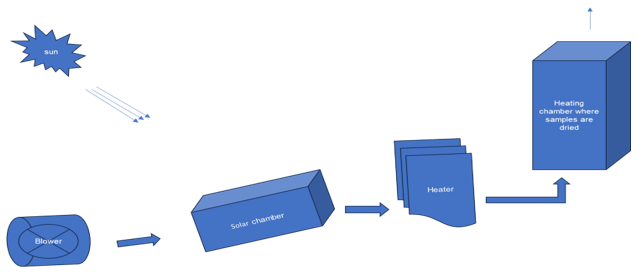
In this study, a multi-functional dryer utilizing electric and solar energy sources was designed and fabricated. Its performance and efficiency were evaluated at 55°C, 60°C, and 65°C using cassava and red pepper. The blower, solar chamber, heater, and heating chamber were the major components of the dryer. The Bill of Engineering Measurement and Evaluation revealed a total of $260 was spent. The weight and moisture content were reduced as the drying time and temperature were increased for both the cassava and the red pepper. Higher removal of moisture was noticed at the initial stage of drying before constant weight was attained after some drying periods. For red pepper, the percentage of moisture removed was 71.51%, 74.5%, and 80.77% while the dryer performance was 14.89 kg/hr, 18.63 kg/hr, and 25.24 kg/hr at 55°C, 60°C and 65°C respectively. For cassava, the percentage of moisture removed was 84.66%, 89.3%, and 90.62% while the dryer performance was 33.86 kg/hr, 35.71 kg/hr, and 41.43 kg/hr at 55°C, 60°C and 65°C respectively. In conclusion, the designed and fabricated multi-functional electric-solar driven dryer was effective for drying the examined products and can be adopted by local farmers due to its high efficiency and low cost.
Graphical abstract of multi-functional electric-solar driven dryer:
Keywords: Drying time, moisture content, dryer performance, design, fabrication
How to Cite
Downloads
References
Gallali YM, Abujnah YS, Bannani FK. Preservation of fruits and vegetables using solar drier: A comparative study of natural and solar drying, III; chemical analysis and sensory evaluation data of the dried samples (grapes, figs, tomatoes, and onions). Renewable Energy. 2000;19:203–212.
Abubakar S, Umaru S, Kaisan MU, Umar UA, Ashok B, Nanthagopal K. Development and performance comparison of mixed-mode solar crop dryers with and without thermal storage. Renewable Energy. 2018;128:285–298.
Wang W, Li M, Hassanien R, Hassanien E, Wang Y, Yang L. Thermal performance of indirect forced convection solar dryer and kinetics analysis of mango. Applied Thermal Engineering, 2018;134:310–321.
Zoungrana A, Çakmakci M. From non‐renewable energy to renewable by harvesting salinity gradient power by reverse electrodialysis: A review. International Journal of Energy Research. 2021;45(3):3495-522.
Ekechukwu OV, Norton B. Review of solar-energy drying systems: II: An overview of solar drying technology. Energy Conversion & Management. 1999;40:615–655.
Hayatu, FA, Dukku MM. Development and performance evaluation of a dual energy source solar dryer for tomatoes. Global Journal of Engineering and Technology Advances; 2022.
Banout J, Ehl P, Havlik J, Lojka B, Polesny Z, Verner V. Design and performance evaluation of a Double-pass solar drier for drying of red chilli (Capsicum annum L.). Solar Energy. 2011;85:506–515.
Hegde VN, Hosur VS, Rathod SK, Harsoor PA, Narayana KB. Design, fabrication and performance evaluation of solar dryer for banana. Energy, Sustainability and Society. 2015;5:23.
Balogun MB, Anafi FO, Kulla DM. Performance evaluation of a double compartment Solar Dryer. Nigerian Journal of Solar Energy. 2017;28:1-8.
Kilanko O, Ilori TA, Leramo RO, Babalola PO, Eluwa SE, Onyenma FA, Ameh NI, Onwordi PN, Aworinde AK, Fajobi MA. Design and Performance Evaluation of a Solar Dryer. Journal of Physics: Conference Series. 2019;1378:032001.
Purohit P, Kumar A, Kandpal TC. Solar drying vs. open sun drying: a framework for financial evaluation. Solar Energy. 2006;80:1568–1579.
Bhuyan J, Mohanty D, Jayapuria D. Comparative study between solar dryer and open sun dried tomato under North Plateau Climatic Zone. Journal of Krishi Vigyan. 2019;8(1)28-33.
Ayanlade A, Atai G, Jegede MO. Variability in atmospheric aerosols and effects of humidity, wind and InterTropical discontinuity over different ecological zones in Nigeria. Atmospheric Environment. 2019;201:369-80.
Lingayat AB, Chandramohan V, Raju V, Meda V. A review on indirect type solar dryers for agricultural crops–Dryer setup, its performance, energy storage and important highlights. Applied Energy. 2020;258:114005
Egwu PN. Impact of agricultural financing on agricultural output, economic growth and poverty alleviation in Nigeria. Journal of Biology, Agriculture and Healthcare. 2016;6(2):36-42.
Ingram JS, Humphries JRO. Cassava Storage – A Review, Tropical Science, 1972;14(2):87–92.
Jakubczyk TE. Roots and Tubers Processing in Some African Countries, In: African Regional Centre for Technology (ARCT). Roots and Tubers Production, Storage, Processing and Marketing in Africa Dakar. 1982:112–126
Hilly M, Adams ML, Nelson SC. A study of digit fusion in the mouse embryo. Clin Exp Allergy. 2002;32(4):489-98.
Jiang D, Xiao H, Zielinska M, Zhu G, Bai T, Zheng Z. Effect of pulsed vacuum drying on drying kinetics and quality of roots of Panax notoginseng (Burk.) F. H. Chen (Araliaceae). Drying Technology. 2020; 0(0):1–18
Boateng ID, Yang X. Effect of different drying methods on product quality, bioactive and toxic components of Ginkgo biloba L. seed. Journal of the Science of Food and Agriculture. 2020;101:3290–3297
Benseddik A, Azzi A, Zidoune MN, Khanniche R, Besombes C. Empirical and diffusion models of rehydration process of differently dried pumpkin slices. Journal of the Saudi Society of Agricultural Sciences. 2019;18(4):401–410.